
Recruiters have heard the pitch for a few years now: AI will free them up to focus on the parts of the job that actually require judgment.
But how much of that promise has actually landed in 2026? What is AI doing in talent acquisition today, and what’s still squarely a human call? This article explores what recruiters are handing over to AI, what they are not, and the reasoning behind their choices.
Where AI is helping most
A recent study found that companies using AI saw faster hiring and more accurate initial screening — a pattern that held up as statistically reliable.
Plus, a survey of 225 HR professionals worldwide, conducted by HR.com between July and September 2025, reports that about 70% believe AI saves time.
The primary use of AI in recruitment is content generation. About two-thirds of HR professionals use AI to create interview questions (67%) and write job descriptions (65%), according to the HR.com survey.
AI usage in decision-making, candidate engagement, and workflow automation remains limited: only 44% use AI for resume filtering, 43% for candidate communication, 36% for sourcing, and 34% for automated note-taking.
Where things can get shaky
About 58% of HR professionals cite risk of bias in AI systems as a top concern, followed by depersonalization of the recruitment process (51%), legal risks (50%), and inaccuracy (43%).
This caution is reflected in adoption levels too. The bulk of HR professionals (49%) use AI only to some extent, and primarily for content generation. Only 14% use it to a large extent, while 37% don’t use it at all.
Regarding compliance, it’s important to remember that the EU AI Act categorizes the AI tools used to screen, rank, or match candidates as high-risk systems — and imposes obligations not only on the vendors who build the systems but also on the employers that use them. Under the Digital Omnibus, the majority of those obligations don’t take effect until December 2027; most transparency requirements under Article 50 arrive sooner, in August 2026.
According to the legislation, recruiting systems must be used with effective human oversight. In other words, no AI tool should have the authority to make a final decision about rejection without a qualified human involved.

The “AI vs. AI” problem
Another issue with AI is that applications are starting to look identical — because candidates increasingly use AI to tailor CVs to specific roles and generate matching cover letters. Recruiters are left sorting through polished but homogeneous applications, with less signal to work from.
According to the HR.com survey, about half of HR professionals report encountering candidates who use generative AI tools frequently (29%) and very frequently (19%). Fewer report rare usage (8%) or never (15%).
On the other end of the process, an AI screener is often the first thing reading that AI-generated content. Both sides — recruiters and candidates — are optimizing for the same goal of saving time, which is rational on its own terms. Still, for recruiters, the dynamic narrows what the process can actually tell about a candidate’s real capability.
In this scenario, networking and behavioral sourcing gain relevance — signals like real engagement history or a direct referral are harder to manufacture at scale. We’ll talk about behavioral sourcing later on.
Using AI without the hype
Remember, using AI is not the goal; it’s the method. The goal is to increase efficiency.
A rule of thumb is: first, design the work, then apply the technology where appropriate.
Especially if your organization hires just a handful of people per year, the focus should be on building a smooth process first — add AI where it can remove bottlenecks or automate administrative work.
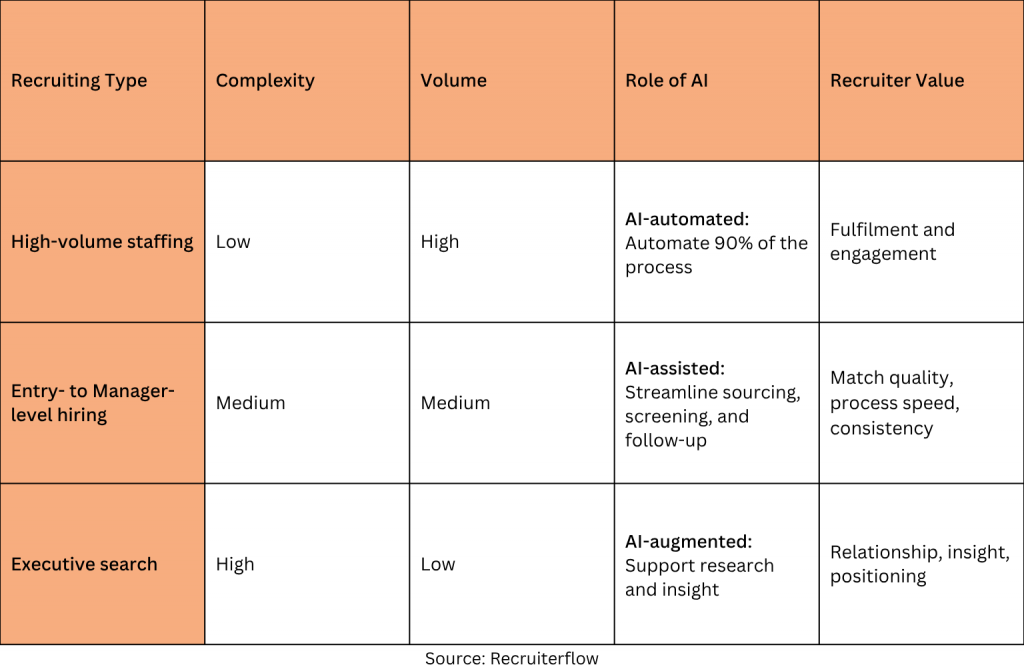
Now, if your company is hiring for high-volume, low-complexity roles, using AI will have a greater impact. AI can automate most of the process in such cases, from sourcing and screening to assessment and offer.
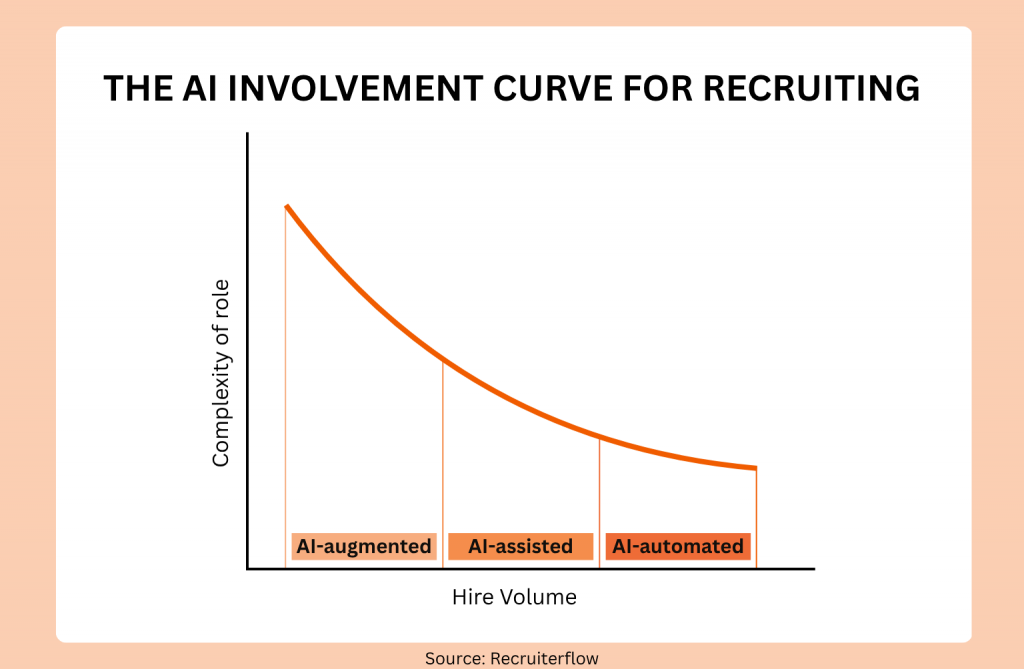
For entry- to manager-level hiring, the process should be AI-assisted; that is, AI can streamline sourcing, screening, and follow-up. The recruiter here should focus on ensuring match quality and process speed, and on gaining insights for optimization.
Finally, for roles with high complexity (e.g., executive search or niche/highly specialized skills) and low hiring volume, AI should augment the recruiting process. The recruiter’s role here is about relationship building, insight, and positioning.
The opportunity for recruiters who use AI more extensively
In the hunt for top talent, recruiters who already use AI beyond content creation can get an edge over the ones who don’t.
Gone are the days of building out complicated Boolean search strings, as recruiters can now type plain-language search terms (e.g., “full-stack developer with React and Node.js experience”) to comb through huge candidate databases, since these tools can recognize different labels that describe the same expertise.
AI also enhances behavioral sourcing — a recruiting method that finds job candidates by analyzing their online footprint (e.g., what they are reading or engaging with) rather than relying on keyword searches. This approach prevents recruiters from different companies from converging on the same shallow pool of “keyword-match” candidates. A human can’t manually monitor engagement patterns across thousands of profiles, but AI can flag the signals worth acting on.
Once the AI has done its job, a recruiter can contact the developer, and a good approach is to be transparent that AI identified the profile, triggered by a specific signal, but that they personally reviewed their public work (code, writing, talks, whatever the signal was) before reaching out.
AI can support the research side of recruiting — benchmarking salary ranges for a role in a specific location, gauging talent availability for a given skill set, or checking what’s become standard practice on things like flexible work policies. This kind of market intelligence used to take hours of manual digging; recruiters can now get an answer in minutes, helping them calibrate a job ad or compensation range before it goes out.
AI tools can also enhance candidate experience by flagging communication gaps. For example, recruiters can set an alarm to be notified whenever a candidate hasn’t been contacted for a set number of days. AI can also draft personalized updates for those candidates.
Recruiters can go even further by using AI-enabled analytics tools to cross-reference employee performance data and identify criteria that predict success in specific roles.
AI can also help identify bottlenecks in the hiring process. For example, by using an MCP that integrates your ATS with Claude, you can get visibility on issues and practical advice.
Getting started with AI agents
The next frontier is AI agents — autonomous/semi-autonomous software systems capable of taking multi-step actions across platforms to achieve a specific goal.
In recruitment, AI agents can search for candidates, reach out to them, and schedule interviews across time zones without needing human prompts. However, just 13% of HR professionals surveyed by HR.com are actively using AI agents for recruiting tasks, while 50% are exploring their potential and 37% have no plans to use them.
A great way to get started is to pilot AI agents for low-risk tasks, such as automated note-taking, and learn gradually while monitoring it closely — because yes, AI agents can also get lazy or misbehave.
Where AI is not so important
According to a survey conducted by asynchronous interview platform Willo, 78.7% of hiring professionals believe final hiring decisions must remain human-led. The survey interviewed over 100 hiring professionals between September and October 2025, and not a single respondent said they believed automation could effectively handle all stages of the hiring process. This discretion is aligned with European legislation.
Wrapping up
In 2026, recruiters are not asking themselves whether they should use AI, but how and where in the process it earns its keep.
Final calls on who gets hired remain, by regulation and by preference, a human one. Again, under the EU AI Act, no AI tool should have the authority to make a final decision about rejection without a qualified human involved. That means HR leaders must train their teams to fully master the AI-powered recruitment tools they use — understanding the criteria, interpreting output, and watching for errors and bias — not just deploy them.
Far from being automated away, talent acquisition is shifting. The recruiter’s role moves toward employer branding and positioning, relationship-building, and process oversight.
Want to stay informed with content that matters?
Join 30,000+ HR professionals and tech leaders: subscribe to the TechTalents Insights newsletter and get our best articles and interviews, completely free.