
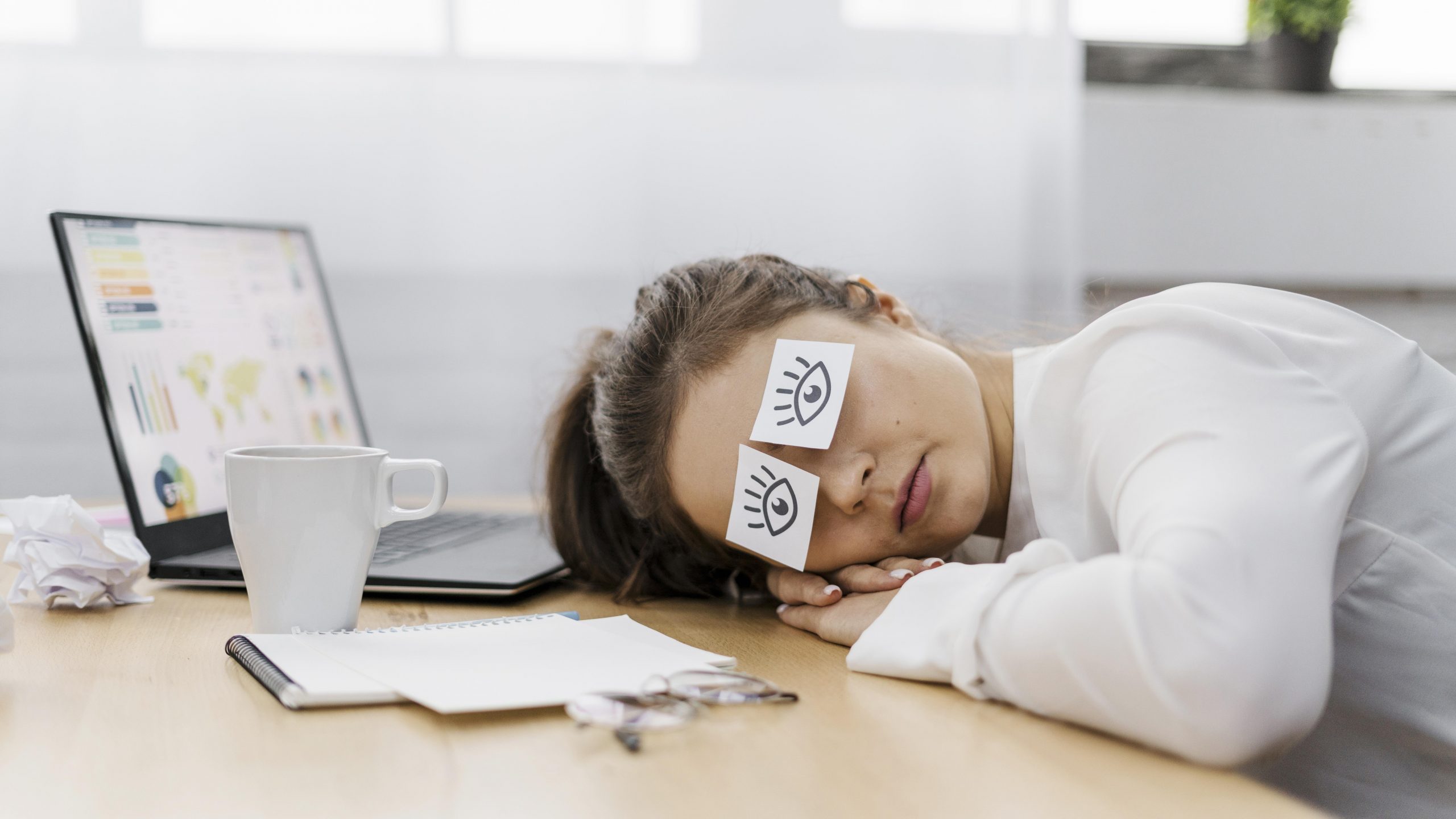
Many of us may take sleep for granted. Yet sleep is a fundamental biological necessity just like food or water. This fact is especially clear to the millions of individuals worldwide who experience insomnia: a survey conducted by RAND across 16 countries found that, if they could, they would be willing to give up approximately 14% of their income to recuperate the well-being lost due to poor sleep.
In its 2025 Sleep in America® Poll, the National Sleep Foundation (NSF) says that individuals with poor sleep health are 4 times more likely to be unhappy, 2.5 times more likely to be unproductive at work, and 3 times more likely to fail to achieve their goals.
Do you have a sleep problem? Take the NHS self-assessment
The NHS (UK’s National Health Service) provides a valuable, free resource to assess whether you have a sleep problem. You can take the self-assessment here — it gives you a ‘sleep score’ and practical tips for improving your sleep. The test is based on a test by Sleepio, a six-week sleep improvement program based on Cognitive Behavioral Therapy for Insomnia.

How to improve your sleep
When people sleep well, they report benefits such as increased energy, improved focus and concentration, better overall mental health, and stronger stress management. As the American Academy of Sleep Medicine (AASM) puts it, “Sleep works for you so that you can perform your best on the job.”
Here are some tips for you to get a good night’s rest:
Maintain a consistent sleep routine
Try to go to bed at the same time every night — including weekends — to strengthen your body’s sleep-wake cycle.
Give your brain time to unwind
You should also set a fixed time to start winding down, since your brain won’t turn off in a second as if it had a switch. Avoid electronic devices for at least an hour before bedtime, as they emit blue light that disrupts sleep.
Use this time to read a bit, listen to soft music, or meditate. Try to avoid e-books, though — in one experiment, e-book readers stayed awake 10 minutes longer than paper book readers, even when reading the same text.
Avoid stimulants in the evening
There’s ongoing debate about the specifics here, especially how many hours before bedtime you should start avoiding stimulants — such as caffeine, alcohol, and nicotine.
A good approach is to experiment a bit with your own cut-off times and pay attention to how your body responds. For some people, avoiding coffee after noon works best; for others, stopping four hours before bed may be enough.
You should also avoid heavy, large meals before bedtime.
Create a sleep-friendly environment, and be mindful of screen time
If you can, make improvements to your bedroom to ensure it’s dark, cool, and silent at night. If needed, wear an eye mask and earplugs.
Remember to put your phone on silent or even remove it from your bedroom completely. Social media platforms are designed to be addictive, and our brains are now wired to pay attention to them. The mere presence of our phone in the bedroom may require us to continually inhibit our impulse to pick it up — even if we are not fully aware of this internal struggle. And once we pick them up, the blue light and mental stimulation do the remaining work of keeping us awake.
In his book “The Attention Fix,” Swedish psychiatrist Dr. Anders Hansen explains that our brains are not designed to cope with the demands of a digital lifestyle. Being disciplined with phone usage is crucial for improving sleep quality.
Move your body — so it needs to rest
Try to exercise regularly, but make sure not to do it right before bedtime.
Track your sleep patterns
You can use a sleep-tracking tool or keep a sleep journal to help you detect patterns.
Discuss your sleep habits with your doctor
Resmed’s 2026 Global Sleep Survey found that although 66% of respondents say they would likely seek professional help for sleep issues, only 23% have done so. The reasons vary: some view sleep problems as a normal part of life (it’s not!), while others say they would wait until things get worse before seeking help. In the meantime, they keep struggling with poor sleep. Remember, no one should have to wait until they feel miserable before talking to a doctor.
Poor sleep: causes and consequences
Modern life has impoverished the quality of our sleep. Primary factors include stress, lack of physical activity, and excessive use of electronic media, among others.
A consistent lack of sleep is linked to long-term health consequences, including diabetes, high blood pressure, and heart disease — chronic conditions that may shorten life expectancy.
Poor sleep can also affect mental health, as it leads to an increase in the production of cortisol, commonly known as the “stress hormone.”
Presenteeism and absenteeism
Sleep deprivation is not just a personal health issue but also a major economic concern. Sleep disturbances are often-overlooked factors in decreased workplace productivity. They lead to a phenomenon known as “presenteeism”: showing up at work but being less productive.
According to the study by RAND, workers who experience any symptoms of insomnia miss 14 days of work every year and spend another 30 days at work but not being really productive. Chronic insomnia sufferers are absent for up to 18 days and present but not productive for up to 54 days.
The researchers used these numbers to calculate that the United States loses over 1% of its total economic output to chronic insomnia every year, which amounts to approximately USD 207.5 billion. The United Kingdom loses 1.3% of its output every year, or USD 41.4 billion. France incurs a loss of 1.2% of its output, or USD 36.3 billion.
However, the costs of sleep deprivation can extend far beyond lost productivity. The financial impact could be even higher if sleep deprivation leads to a disaster.
Sleep deprivation and disasters
If you consider news coverage of high-profile disasters in recent decades, you know that insufficient sleep did not dominate the narrative or discussions. However, this does not mean it did not contribute to these major incidents. According to the Division of Sleep Medicine in the Harvard Medical School, investigations concluded that sleep deprivation played a role in the accidents at Three Mile Island in the U.S. (1979) and Chernobyl (1986), the Exxon Valdez oil spill (1989), and the explosion of the space shuttle Challenger (1986).
When we consider that impairment caused by sleep loss can be like being drunk, it’s easy to understand why it’s so dangerous.
The impact of sleep deprivation on neurobehavioral performance is also evident in medicine. For example, a 2004 study led by Dr. Charles Czeisler of the Division of Sleep Medicine at Harvard Medical School found that the number of serious medical errors made by interns were 35.9% higher during a traditional work schedule compared to an intervention schedule that eliminated extended work shifts.

What actions can employers take to address sleep disturbances?
The RAND study lists some actionable measures for employers, particularly Human Resource departments. We list them below.
Educating employees about sleep disturbances
Employers should educate employees about the symptoms of insomnia, its effects on cognition, health, and overall well-being, as well as the associated risks, such as errors, accidents, and injuries.
Limiting communication after working hours
Employers should also foster a culture that promotes sleep health by limiting email communication outside work hours. Of course, if it’s a global company, such a policy may not be feasible, but still, managers can promote sleep health by not demanding responses to emails after work hours.
Employers can also adopt flexible schedules and implement family-leave policies. The latter are important because some life events — such as the loss of a family member or the arrival of a new child — can trigger insomnia.
Providing workspaces with natural light
Another important preventive strategy may be making enhancements to the office environment, such as using circadian-effective lighting or providing exposure to daylight.
Offering access to Cognitive Behavioral Therapy for Insomnia
The study also suggests that, as part of an overall ‘wellness package’, employees should receive resources for managing insomnia — such as access to Cognitive Behavioral Therapy for Insomnia (CBT-I). It also emphasizes that these resources are particularly important for employees in high-risk work environments.
Quick facts about sleeping
What’s disturbing people’s sleep?
The Resmed study indicates that 83% of people across 13 countries report facing barriers to getting quality sleep. The top five barriers are stress or anxiety (39%), work (22%), screen use before bed (21%), household responsibilities (19%), and sleep disorders (18%). The survey included 30,000 individuals across the United States, Australia, China, Japan, Korea, India, Singapore, the United Kingdom, France, Germany, Poland, Brazil, and Mexico.
The same research found that sleeping can be more challenging for people in relationships — when they share a bed with their partners. About 80% of those in relationships have disrupted sleep due to their partner. The most common causes of partner sleep disruption include snoring or loud breathing (36%), the partner getting up (25%), different sleep and wake schedules (21%), and their partner using their phone or tablet in bed (18%). Women are more likely than men to report that their partner’s snoring or loud breathing disrupts their sleep, with 43% of women and 28% of men indicating this issue.
The most sleep-deprived nation
Japan has consistently been ranked as the most sleep-deprived nation in the world. One netizen pointed out a vicious cycle: the Japanese often sacrifice sleep for work, and when their productivity declines, they feel compelled to work longer hours and get less sleep.
What’s the most common sleep disorder?
Insomnia is the most common sleep disorder. It is characterized by difficulties falling asleep, staying asleep, or obtaining quality restful sleep. Individuals who experience those symptoms three or more times a week, with impairment to daily activities, are considered to have clinical insomnia; when symptoms persist for at least three months, the diagnosis is chronic insomnia.
In RAND’s survey, researchers estimated that approximately one-third of the adults, or 172 million people, experience symptoms of insomnia. About 8% suffer from chronic insomnia — that’s 42 million people who are functioning in survival mode. The countries included in the survey are Australia, Canada, the United States, Finland, Norway, Sweden, Greece, Italy, Portugal, Spain, Austria, Belgium, France, Germany, Switzerland, and the United Kingdom.
How many hours of sleep is too much?
The debate about sleep has expanded into popular culture, especially as celebrities promote oversleeping. Actress Dakota Johnson sparked discussion in 2023 when she told the Wall Street Journal that she is not functional unless she gets a minimum of 10 hours of sleep each night. She mentioned that she can easily sleep up to 14 hours a night, stating, “Sleep is my number one priority in life.”
Oversleeping has recently inspired literature: the successful novel “My Year of Rest and Relaxation” (2018) by Ottessa Moshfegh is a darkly hilarious tale about a woman who decides to hibernate for a whole year to heal from depression.
However, sleeping too much is not necessarily self-care. Investigators have ruled that habitually getting over 9 hours of sleep is also linked to poor health. One study found that both insufficient sleep (less than 6 hours) and excessive sleep (more than 9 hours) increased the risk of coronary heart disease in women.
Get more content like this!
Enjoying our content? Subscribe to the TechTalents Insights newsletter to start getting our best articles and interviews delivered to your inbox.