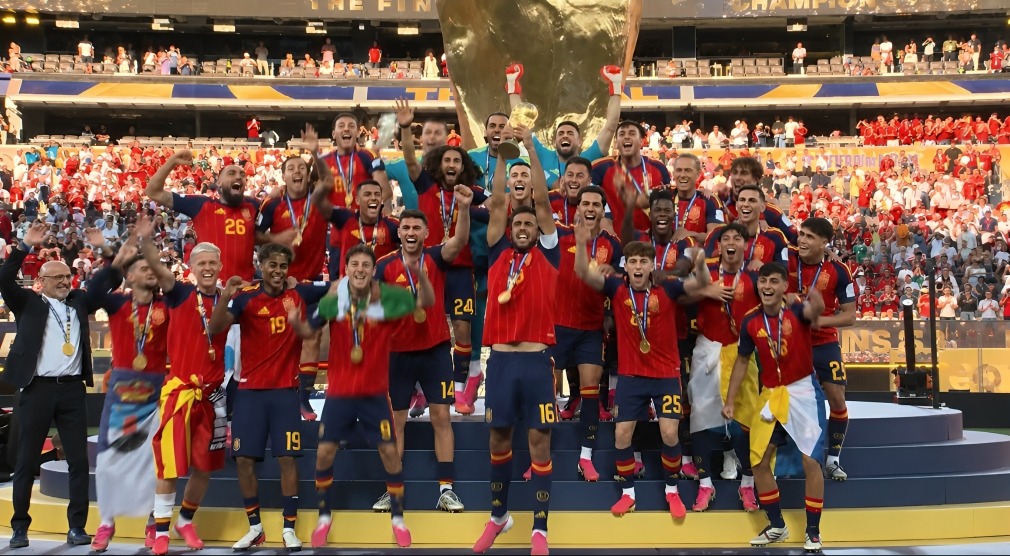
After 104 matches across three countries, the 2026 FIFA World Cup came to an end this Sunday (19), crowning Spain as the new champion with a 1-0 win over Argentina. This tournament offered a few lessons that translate surprisingly well to how we build and run tech teams. Here’s what stood out.
Stars won’t bring you success unless they make a solid team
France has some of the biggest football stars on the planet, like Mbappé and Dembélé, but individual talent wasn’t enough for Les Bleus to win the World Cup. Think of the 2022 final, when Mbappé was phenomenal against Argentina — he scored a hat-trick — and still lost the match and the tournament. This time, France lost in the semifinals to Spain, a team with lesser-known stars that dominates the ball and puts the collective above the individual. Even Spain’s most famous footballer, Lamine Yamal, plays like someone who puts the group first.
Not every underperformer should be let go
Spanish forward Ferran Torres spent most of the tournament as a target for criticism, with no goals — a painful stat for a striker, whose entire job is scoring. Then, in the 106th minute of the World Cup final, he scored the goal that won Spain the title (the goal involved Lamine Yamal, Pedro Porro, and Nico Williams in the buildup).
For tech teams, the lesson isn’t “everyone struggling will eventually deliver” — that’s not true. A manager, like a football coach, should be able to tell the difference: is this person in a rough patch that could end with a breakthrough, or a genuine mismatch that keeps draining the team? Torres kept his place because the coach, Luis de la Fuente, saw something in training and in matches that the scoreline didn’t show.
Managing people means reading the signal underneath the numbers. If you see effort and commitment, maybe they’re a keep — not out of charity, but because pulling this type of underperformer before they get their moment could cost you the win.

It’s not over ’til it’s over
Argentina staged unbelievable comebacks during this tournament, against Egypt and England. Love or hate Argentina’s style, one thing’s for sure: Messi and his teammates never give up. Every minute counts for them, and no match is lost until the final whistle. They keep fighting — and so should your team.
Having fewer resources doesn’t mean you’re out of the fight
Cape Verde, an archipelagic country of just 530,000 inhabitants in West Africa, made its World Cup debut with a team that proved far stronger than the sum of its individual parts. Now, with the final between Argentina and Spain, their feat has become even more astonishing: none of the finalists was able to beat Vozinha’s team during normal time.
Part of how coach Bubista pulled it off: he widened his talent pool beyond national borders, scouting Cape Verde’s diaspora across Portugal, the Netherlands, and Ireland — a reminder that the best hire for the role isn’t always the one already sitting in your local pipeline. He also made the Cape Verdean Football Federation proactively reach out to players who were not looking for an opportunity.
But a wider pool only works if what you build with it holds together. Alignment, commitment, shared purpose and motivation often matter more than individual talent. Plus, Bubista managed to assemble a team that played without fear — remarkably, England, a team with global stars such as Jude Bellingham and Harry Kane, played against Argentina with far more visible fear than Cape Verde ever showed.
Resilience is a talent
Vozinha’s story adds another lesson: experience matters, and resilience is a talent in its own right. The goalkeeper spent a decade in modest leagues, working side jobs to get by, before his defining moment arrived at 40. Hiring managers chasing hyped candidates might be overlooking their own Vozinhas: battle-tested people who just haven’t had the right stage yet.
Wrapping up
The teams that go furthest aren’t always the ones with the most talent. They’re the ones that are the smartest at maximizing their resources, build something bigger than any single player, and believe in themselves enough to always keep fighting.
Want to stay informed with content that matters?
Join 30,000+ HR professionals and tech leaders: subscribe to the TechTalents Insights newsletter and get our best articles and interviews, completely free.