

The Pay Transparency Directive 2023/970 imposes pay transparency and reporting obligations on employers based in the European Union, as well as on companies employing workers within the European Union. The goal is to reduce the pay disparity between female and male workers — in 2024, the average unadjusted gender pay gap in the EU was 11.1%.
EU Member States had until June 7 this year (2026) to transpose the Directive into national law. However, only four member states met that deadline: Italy, Slovakia, Lithuania, and Malta. European Commissioner for Equality Hadja Lahbib warned that non-compliant nations could face infringement proceedings.
For more context on the Directive and its rationale, see this article.
Below are the answers to nine common questions about the new rules.
Which companies are required to report?
Employers with at least 100 employees are subject to gender pay gap reporting as outlined in the Directive. However, deadlines and reporting frequency vary based on company size:
- Employers with at least 250 employees must publish their first reports by June 2027 and every year thereafter.
- Employers with 150–249 employees must publish their first reports by June 2027 and every three years thereafter.
- Employers with 100–149 employees must publish their first reports by June 2031 and every three years thereafter.
So, in this first stage, only companies with at least 150 employees will be required to report. As of five years after the transposition deadline (June 2031), the requirement will be extended to companies with 100–149 employees.
Therefore, the EU Directive exempts companies with fewer than 100 employees from the gender pay gap reporting requirements. However, there’s a catch: Member States may choose to enact stricter local laws requiring companies with fewer than 100 employees to report. For instance, the latest draft of France’s bill mandates reporting for companies with at least 50 employees.
Employers must proactively prepare to justify pay differences using objective, gender-neutral criteria. Remember, pay differences are allowed when justified by seniority, performance, or skills.
Now, if a report reveals a pay gap of more than 5% that cannot be justified by gender-neutral criteria, and the company has not remedied the unjustified difference within six months of submitting the report, the employer will be required to conduct a joint pay assessment in cooperation with workers’ representatives. According to the Directive, joint pay assessments should lead to the elimination of gender-based pay discrimination through the adoption of corrective measures — within a reasonable period of time.
Importantly, the Directive uses a broader definition of pay, stating: “The principle of equal pay should be observed with regard to wages, salaries or any other consideration, whether in cash or in kind, which workers receive directly or indirectly, in respect of their employment from their employer.” For employers, this broader definition means that they must be mindful of all forms of pay discrimination, including benefits, bonuses, and other rewards.

Do I have to provide salary ranges in job ads?
The answer is: it depends.
The Pay Transparency Directive itself does not require the salary to be published in the job advert. This is what it states, ipsis litteris: “Applicants for employment should receive information about the initial pay or its range in a manner such as to ensure an informed and transparent negotiation on pay, such as in a published job vacancy notice, prior to the job interview, or otherwise prior to the conclusion of any employment contract.”
As you can see, the wording leaves room to inform the candidate about the pay at any moment during the recruitment process.
That said, companies will need to comply with the local rules in the countries in which they operate. Ireland and Poland, for example, have implemented stricter rules requiring employers to provide pay information to candidates earlier in the hiring process.
Do I have to share average salary information with employees who request it?
Yes. Once in the role, an employee will be entitled “to obtain information, upon their request, on their individual pay level and on the average pay levels, broken down by sex, for the category of workers performing the same work as them or work of equal value to theirs.” This right applies to employees of companies of all sizes in the European Union.
The employer also should, on an annual basis, inform workers of their right to request information, along with the steps required to exercise that right.
Additionally, employers should make accessible to workers the criteria being used to determine pay levels and pay progression.
What is considered “work of equal value”?
As we saw in the previous section, a key concept of the Direct is “work of equal value.” But what exactly does that mean?
Under Article 4 and Recital 26 of the Directive, the value of work must be assessed and compared on the basis of four essential factors: skills, effort, responsibility, and working conditions.
Tech Talents Insights consulted Marianna Baggio, Research Officer at Eurofound, an EU agency, for more information on how to assess each criterion.
Regarding skills, Baggio says these encompass knowledge, competencies, and abilities required for the job, whether acquired through formal education or practical experience.
The Directive emphasizes that “relevant soft skills shall not be undervalued.” According to Baggio, these skills “are often neglected in standard job evaluation processes, yet they account for many of the skills that are fundamental in female-dominated jobs.” To illustrate the point, she points to the example of a nurse who must interact with patients’ families, “bringing kindness, understanding, and clear communication in difficult situations.”
On effort, Baggio emphasizes that the concept goes beyond physical labor alone: “It’s the employee’s response to their workload, measuring both physical and mental or cognitive strain. This means surfacing different forms of physical strain — not only lifting heavy items. A kindergarten teacher who lifts children several times a day is exerting an effort that should be recognized, as it can be genuinely taxing.”
When it comes to responsibility, she explains: “This extends beyond formal hierarchical management to include actual operational accountability across multiple areas, such as responsibility for people’s health and safety, equipment, information, and financial resources.”
The fourth factor concerns working conditions, which Baggio describes as “the physical, psychological, and social environments of the workplace, taking into account exposure to risks, discomfort, and the duration or frequency of those exposures.” She adds: “Returning to the nurse example, this includes the risks associated with exposure to antisocial behavior.”
Baggio points out that employers may also consider additional factors relevant to a specific role or position, as stated in the Directive.
Finally, she highlights that Recital 17 of the Directive establishes that any criteria used to measure these four factors must be simultaneously objective, gender-neutral, and free from bias. In practice, she explains, this means the evaluation must rely on measurable facts (rather than subjective opinions), actively prevent the systemic undervaluation of demands typically associated with female-dominated occupations, and exclude any direct or indirect discrimination based on sex.
Is implementation different across countries in the EU?
Yes. The Directive establishes minimum standards, meaning Member States may adopt stricter local rules when transposing it into national law — as France is planning to do.
Employers with teams in multiple EU Member States must pay extra attention to local regulations.
Can workers sue employers for gender pay discrimination?
Yes, and one of the most significant changes concerns the burden of proof. While, in principle, the burden of proof normally rests with the claimant, the Directive shifts this responsibility to the defendant. In other words, it will now be up to the employer to demonstrate that discrimination has not occurred, thereby enhancing employees’ chances of success in court.
Under the new Directive, workers who have experienced gender pay discrimination are entitled to compensation that includes full recovery of back pay, as well as related bonuses or payments in kind. Importantly, such compensation is uncapped: “The compensation or reparation shall not be restricted by the fixing of a prior upper limit.”
Employers should also be aware that the Directive applies to a broad range of workers, including (but not limited to) part-time workers, workers on fixed-term contracts, trainees, and apprentices. As the text states, “The determination of the existence of an employment relationship should be guided by the facts relating to the actual performance of the work and not by the parties’ description of the relationship.” The Directive also extends to applicants for employment, stating: “An important element of eliminating pay discrimination is pay transparency prior to employment.”

What are the penalties for non-compliance?
The Directive itself doesn’t set specific penalties. Instead, it states: “It is for the Member States to determine the infringements of the rights and obligations relating to equal pay for equal work or work of equal value for which fines are the most appropriate penalty.” The text emphasizes that the penalties should guarantee a real deterrent effect against infringements of the rights and obligations under the principle of equal pay.
As a result, employers should refer to the national laws implementing the Directive in each Member State to understand the applicable penalties.
Am I allowed to ask a candidate about their current salary or expectations?
Employers will be prevented from asking candidates about their salary history. The goal is to prevent past pay discrimination from continuing to affect future compensation. You can already write off this question from your application forms and interviews.
As for salary expectations, the Directive does not prohibit employers from asking candidates about it. However, employers should be cautious: asking about salary expectations before providing an applicant with the initial salary or pay range may undermine the Directive’s goal of transparency. As a best practice, employers should communicate the salary range before discussing compensation expectations with candidates.
What should I do now as an employer?
Employers with at least 150 employees must publish their first reports by June 2027, covering the previous calendar year — namely, 2026. Therefore, the pay structures currently in place will already be taken into account — making it essential for employers to review and, where necessary, adjust their compensation practices now to correct any unjustifiable disparities. If you don’t have objective criteria for salaries and rewards, it’s time to establish them. Proactively addressing the gender pay gap can prevent the need for joint pay assessments and reduce the risk of discrimination claims.
Additionally, employers should review contracts and remove any secrecy clauses that prevent employees from sharing or seeking information about their pay. As stated in Article 7 of the Directive: “Member States shall put in place measures to prohibit contractual terms that restrict workers from disclosing information about their pay.”
Consult a lawyer about the specificities of the local law in the countries where your company operates — if you’re required to disclose pay ranges in any of them, you must identify and address any existing disparities before including the information in ads. Don’t underestimate the internal impact of public salary ranges.
If you’re not convinced, check this tweet that went viral in 2023, written by a writer in NYC, shortly after the city implemented its pay transparency rules:
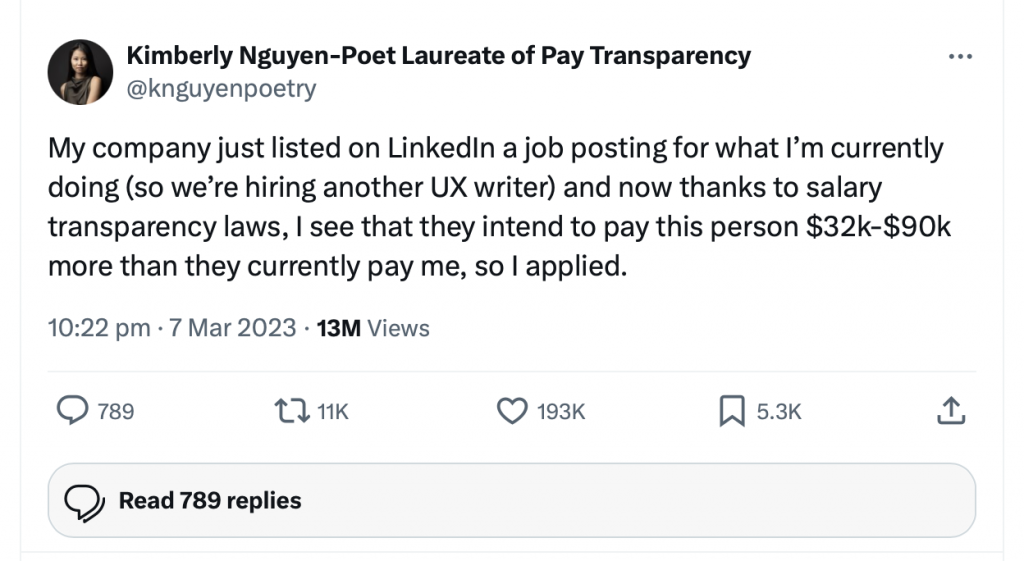
In fact, even in countries where disclosing pay ranges in job ads is not mandatory, employers should bear in mind that workers will now be free to discuss and share compensation information among themselves. So, having a consistent, well-structured pay system will be more important than ever.
Finally, make sure to review your job ads guidelines for gender neutrality, as the Directive requires employers to ensure that both job vacancy notices and job titles are gender-neutral.
Disclaimer: The information provided in this article is for informational purposes only and does not constitute legal advice.
Want to stay informed with content that matters?
Subscribe to the TechTalents Insights newsletter and get our best articles and interviews — completely free.