

If you’re hiring developers, it’s worth knowing what they’re noticing — and what might be quietly pushing them away before the conversation even gets going.
Here’s a list of common red flags developers notice in those first few minutes — and that can make or break their interest early on.
1. If you haven’t read their CV with attention
If you ask unnecessary questions that are answered in their CV, or if you confuse tech stack or seniority, it signals that the company is not so serious. Developers expect baseline preparation (not perfection).
2. If the role description is vague
Hearing “We’re still figuring out the role” can give a developer the chills. It often indicates a lack of clarity about responsibilities, team structure, and the position’s impact. The same thing applies if the role description is filled with buzzwords but lacks specific details. Developers may conclude that the team is chaotic and poorly managed.
3. If the recruiter can’t answer basic technical questions
When the first interview is purely HR with no technical perspective, it signals that tech isn’t central to the company.
That’s why having a recruiter with a strong technical understanding involved early on is crucial. If that expertise doesn’t exist in-house, partnering with tech recruiting services can make a significant difference.

4. If you oversell the culture
Clichés like “we’re like a family” or “we work hard, play hard” tend to raise more concerns than excitement. Many developers read them as signals of overwork, blurred boundaries, or unrealistic expectations. Or simply as a sign that the leadership lacks depth.
The same goes for sounding overly polished: it can come across as inauthentic. Clear, honest insights into how the team actually works will always build more trust.
It’s also worth noting that your energy matters. If you come across as tired or disengaged, it can signal deeper issues about the team or culture. Showing up at your best isn’t always easy — but the same goes for the candidate, and first impressions work both ways.
You don’t need to oversell the company, either. Most developers aren’t swayed by big claims about growth, profitability, or polished sales pitches. What they actually care about is much closer to their day-to-day reality: the team they’ll be working with, whether the project involves building something new or maintaining legacy systems, and the technical challenges they’ll face. The more concrete and honest you are about these details, the more credible and attractive you become.
5. If the interview flow is disorganized
When the interviewer shows up late, it’s already a bad start. It can get worse, though. Repetitive questions suggest a lack of coordination — and hint that internal processes might be just as messy.
The disorganization becomes even more noticeable when multiple interviewers are involved, but they seem out of sync with each other. For developers, that’s a signal of misalignment behind the scenes.
6. If you can’t explain why the role is open
If you avoid the question or fall back on vague, generic answers, it can quickly raise suspicion — often worse than the reality itself.
Developers want to understand the context: is the team growing, or is this a replacement due to attrition? It’s a fair question, and being transparent builds trust from the start.
7. If you are unclear about tech decisions
Answers like “we use a bit of everything” — without any real explanation — are an immediate red flag. When there’s no clear rationale for the tech stack, no sense of ownership, and no clear vision for how decisions are made, developers start to question the team’s maturity. Strong engineers want to understand not just what you use, but why — and who’s driving those choices.
8. If you rely only on LeetCode-style questions
Let’s not get this wrong: LeetCode-style questions — like reversing a linked list, solving a “two-sum” problem, or finding the shortest path in a graph — aren’t useless. They can be helpful, especially for junior roles, as they provide a standardized baseline and test structured thinking.
But they’re not very representative of day-to-day work, and often reward memorization and practice over practical problem-solving. Many developers see over-reliance on them as a sign of outdated hiring practices.
As a CTO recently posted on LinkedIn, “The developers who ace whiteboard interviews and the developers who thrive in production are two completely different groups of people.”
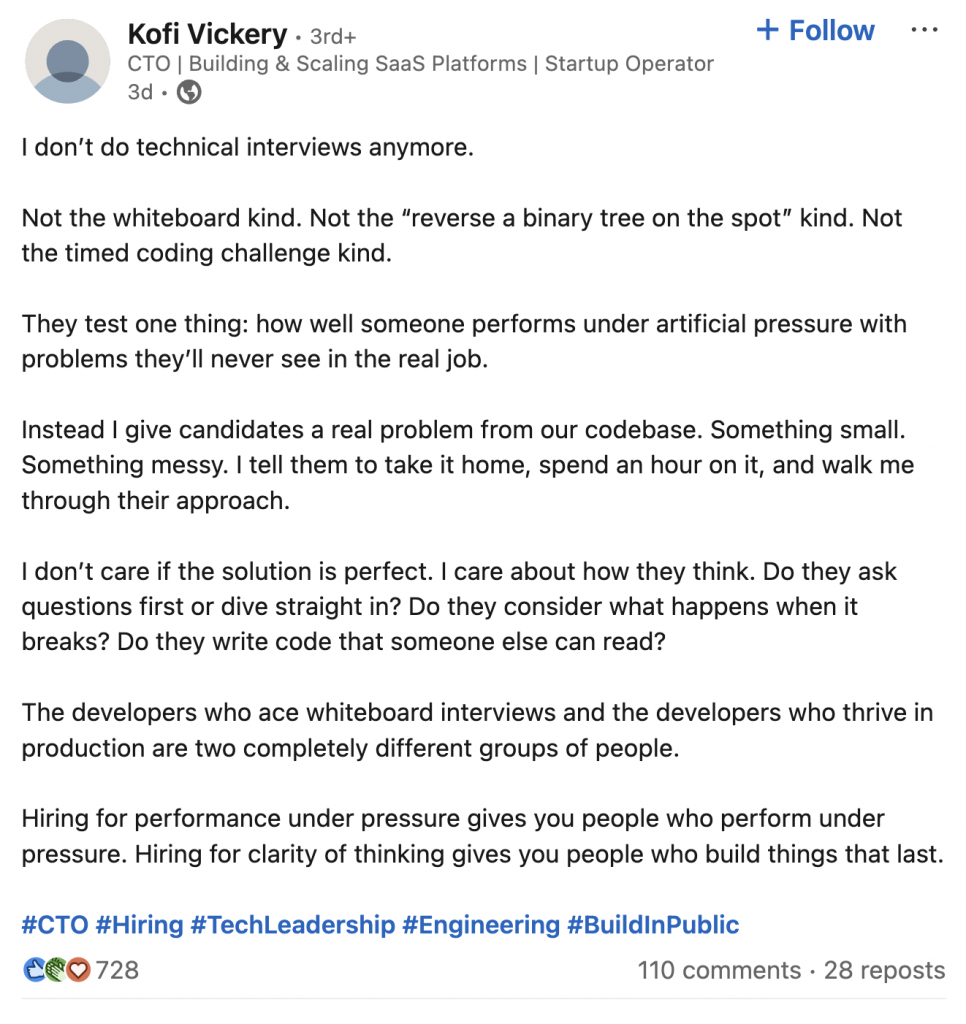
In summary, use the LeetCode-style questions if they add value — just don’t make them your primary evaluation strategy.
9. You sell career growth but can’t show it
If you promise growth but can’t explain what it actually looks like, it quickly feels like an empty pitch. Developers will want specifics: how do people grow here, what paths are available, and how is that progression supported?
10. If you interrupt or talk over them
Cutting candidates off or speaking over them signals not only poor interview etiquette but also a lack of interest in their input.
Developers notice this immediately. It can feel like their perspective isn’t valued or that communication within the team is one-sided.
Strong candidates are assessing how conversations flow just as much as what is being said. If they don’t feel heard in the interview, they won’t expect it to improve once they join.
Wrapping up
If you’ve found yourself doing any of these, don’t panic. We’ve all been less-than-great interviewers at some point. What matters is noticing the patterns and improving.
Small adjustments in how you communicate, structure interviews, and show up can make a big difference in how your company is perceived — and in the kind of developers you attract.
Time to subscribe!
Enjoying our content? Subscribe to the TechTalents Insights newsletter to start getting our best articles and interviews delivered to your inbox.