

Last year, Anthropic CEO Dario Amodei warned that AI could wipe out 50% of all entry-level white-collar jobs within 5 years or less.
That warning quickly started to materialize across tech companies.
In October, Amazon announced that it is cutting 14,000 corporate jobs as it aims to become leaner in the age of AI — prompting Business Insider to describe the moment as the onset of “the era of mega AI layoffs”.
European companies are now following suit, as the so-called “white-collar bloodbath” spreads to this side of the Atlantic and firms begin to recalibrate their workforce expectations.
Last month, Sebastian Siemiatkowski, CEO of Klarna, said the company will likely reduce its workforce by 1,000 employees by 2030 — partially due to AI. Currently, the Swedish fintech employs about 3,000 people, down from 7,000 just 4 years ago. The CEO estimates that in another 4 years, the workforce will likely decrease to fewer than 2,000 employees, marking a reduction of one-third.
Beyond layoffs, AI is changing what expertise is required.
Carmelo Juanes Rodríguez, CEO of Invofox, a San Francisco-based company that provides intelligent document processing, recently posted on LinkedIn about a loop he believes is starting to play out within the technical field:
“AI increases output. Companies ship faster. Fewer people deeply understand what is actually being built.
Speed compounds. So does technical debt. And debt is not visible until something critical breaks.
Then the market suddenly rediscovers a basic truth: someone has to understand the system end to end.
The irony is that AI does not eliminate engineers. It raises the premium on the ones who can reason about architecture, tradeoffs, and failure modes.”
As the job market shrinks, senior technical talent appears relatively protected — for now.

Junior roles at risk: Why it matters in the long run
The current emphasis on senior roles poses a long-term challenge. If entry-level opportunities disappear, how will the next generation of senior developers be trained? Senior profiles only exist because, at some point, they were given the chance to start as juniors, gain experience, and grow.
LinkedIn’s Chief Economic Opportunity Officer, Aneesh Raman, voiced this concern last year. He stated that artificial intelligence is breaking “the bottom rung of the career ladder.” Raman urged colleges to integrate AI into their curricula and companies to assign higher-level tasks to junior roles.
The shift isn’t just about fewer junior jobs, though. The definition of what makes a valuable employee is also changing drastically.
Jasper.ai CEO Timothy Young recently told Fortune: “With the commoditization of intelligence, it’s not about having the smartest people anymore. It’s about developing your staff to have management skills because every employee in the next 12 months is going to have a series of agents that are helping them do their work.”
So, what is the future of software development?
In the Pragmatic Engineer newsletter, Gergely Orosz explored how AI is reshaping the software development market in his article “When AI writes almost all code, what happens to software engineering?” He argues that skills such as rapid prototyping, being a programming language polyglot, or specializing in a specific stack are likely to become less valuable over time.
At the same time, he cautions that increased code generation comes with trade-offs: “More code generated will lead to more problems, weak software engineering practices start to hurt sooner, and perhaps a tougher work-life balance for devs.”
Is there any good news? Orosz writes that tech lead traits will be in higher demand, with product-mindedness becoming a baseline expectation — particularly in start-ups. Being a well-rounded software engineer, rather than just a coder, will matter more than ever.
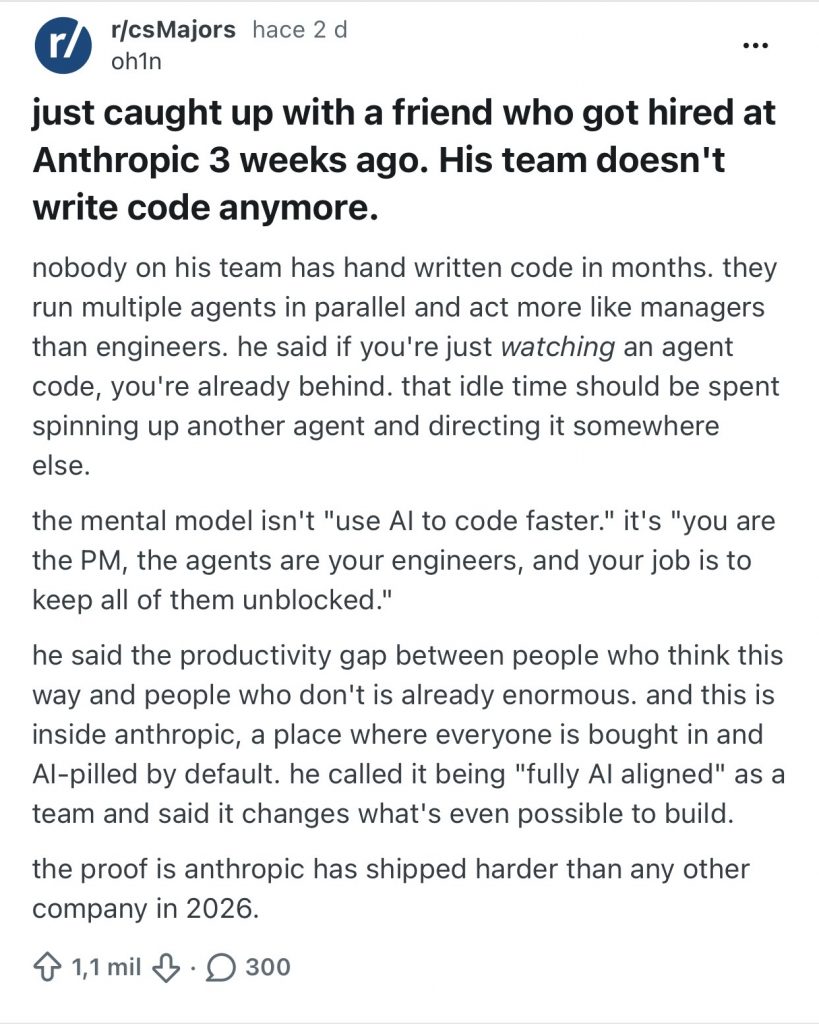
Last week, a post about Anthropic — the company whose CEO predicted the white-collar Armageddon — went viral on Reddit. A redditor wrote, “just caught up with a friend who got hired at Anthropic 3 weeks ago. His team doesn’t write code anymore”. They added that “the mental model isn’t ‘use AI to code faster,’ it’s ‘you are the PM, the agents are your engineers, and your job is to keep all of them unblocked.’”
The Stack Overflow blog stated last month that, “Not only is there a future for software development, but we’re on the cusp of enormous demand for code developed by humans.” In what they called “the optimist’s take,” they emphasized that being optimistic doesn’t mean standing still: “Look, our point isn’t that everything will be fine if you just keep doing what you’ve always done. The world is changing, and developers need to change with it. But the change isn’t from being employed one day to obsolete the next. It’s a shift in how and on what scale we solve problems.”
From developers to operators
The AI revolution is not limited to Big Tech, but is already playing out across teams in companies of all sizes and industries.
We spoke with Erik Arenhill, CTO and the sole developer at Umara, a Swedish sports nutrition company. He believes the developer role is evolving into that of an operator. “As AI takes on more of the heavy lifting in coding, the developer’s role shifts towards architecture, code reviews, and keeping technical debt to a minimum.”
He says that, at Umara, hiring more developers was considered at some point, but that is no longer a necessity. “The main reason we might still hire someone is to avoid having a single point of failure in operating the [e-commerce] platform. In terms of development capacity, it’s not as relevant anymore.”
Arenhill concurs that the impact of AI on software development is most visible at the junior level. “I believe it will be harder to get a job as a junior developer,” he says. “There will still be a demand for skilled developers for some time. However, if you don’t learn to work effectively with the available tools, you risk being left behind.”
He weighs the pros and cons of the transformation. “More code isn’t necessarily better. AI is very good at producing a lot of it and sometimes over-engineering solutions,” he notes. “It requires a massive code review. Although using AI speeds up development, it also increases the amount of testing and review required to ensure quality.”
Arenhill explains how he uses AI himself — as the only developer in the company, he uses AI as a brainstorming partner: “It gives me someone to discuss architecture and different angles while approaching a problem, but AI is a tool; the decision is mine.”
He believes that, in the age of AI, enhancing workflow and quality assurance are paramount. “Never run unreviewed or untested AI-generated code that someone doesn’t understand in production for a starter,” he warns. “That’s why we will still need people to become developers, even if I still believe the demand will become lower.”
His conclusion: “When someone I speak to is scared of AI and the future, I like to ask them if hardware stores should stop selling knives, too, because it’s also a dangerous tool, depending on who will use it and for what. It can either be used to help or hurt someone.”
Get more content like this!
Enjoying our content? Subscribe to the TechTalents Insights newsletter to start getting our best articles and interviews delivered to your inbox.