
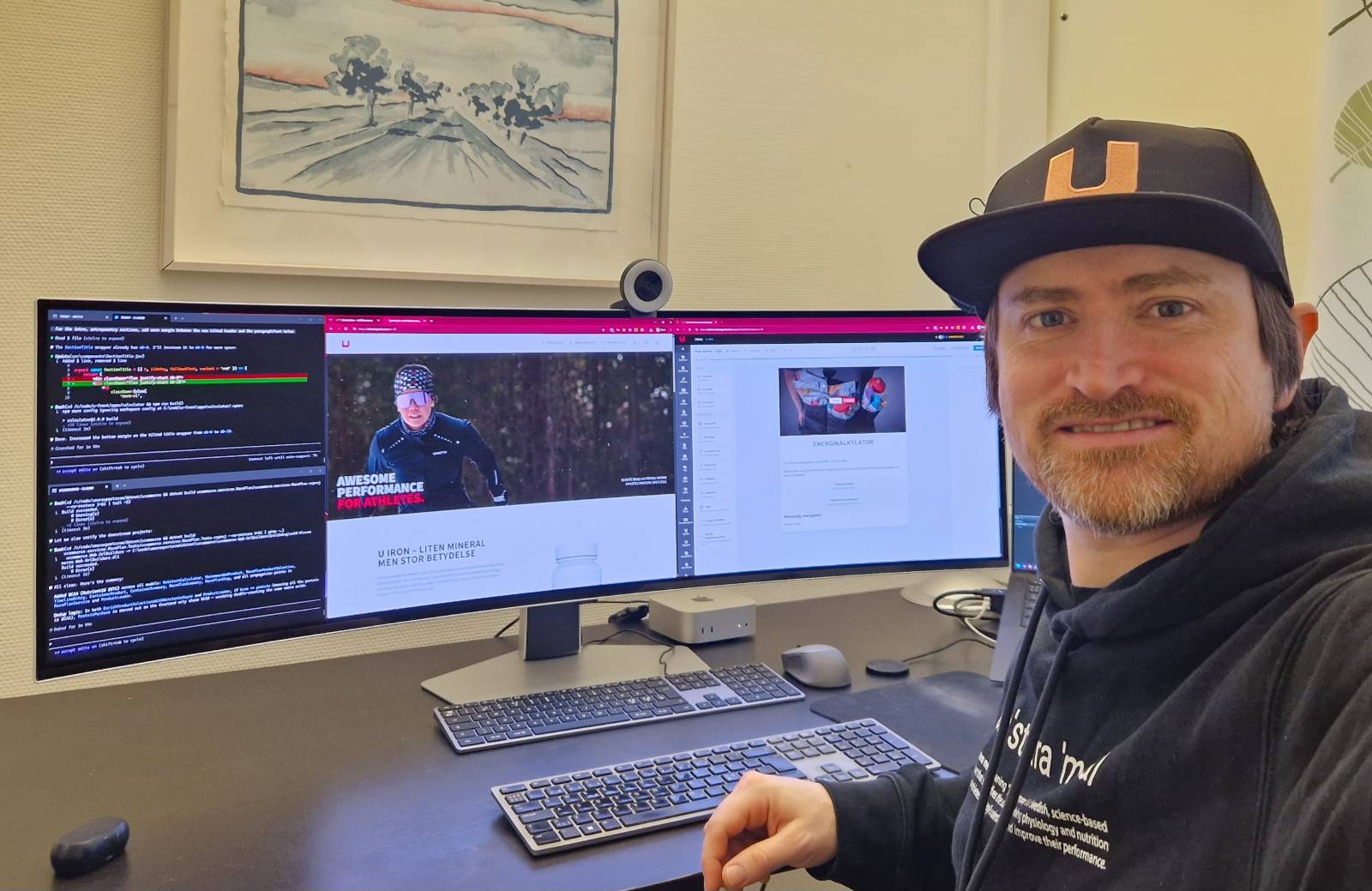
Erik Arenhill is the CTO and sole developer at Umara, a Swedish sports nutrition company going global. Nearly a decade after joining the founders to improve the company’s e-commerce platform, he is now witnessing a fundamental shift in his role and across the organization.
From marketing to engineering, development cycles have accelerated, and the nature of the work itself is changing. He believes developers are increasingly taking on the role of operators.
Arenhill reflects that the shift comes with trade-offs. “While AI’s speed in producing thousands of lines of code can sometimes be impressive, this should also, from time to time, serve as a warning sign,” he says. “It requires a massive code review. Although using AI speeds up development, it also increases the amount of testing and review required to ensure quality.”
Here’s what Arenhill had to say about how AI is reshaping development at a fast-paced e-commerce company.
TechTalents Insights: How has AI changed the development workflow at Umara? What types of problems does it solve?
Erik Arenhill: AI as a tool has greatly improved our time-to-market across the entire company. As we dig through the latest research on human performance, it allows us to recap and summarize text quicker. The marketing department uses AI for imaging, audio, and video processing when creating social media content and podcasts. We use AI basically across the entire organization, adopting new models and services from day one while also building our own internal tools around them.
From a technical perspective, it greatly reduces the time needed to build complex features, refactor legacy code, and write tests. We are also integrating AI directly into our platform to automatically analyze SEO and accessibility, and to automate translations as we expand into new markets. Tasks that previously could take weeks to build can now sometimes be completed in minutes.
It has also changed how we approach feature development. It’s often faster to build a mockup of the feature and discuss it afterward than to spend a long time discussing it before building anything. Importantly, we are a small, fast-paced company; requirements may not be the same in an enterprise.
AI has shifted the focus from “coding takes time; we need to prioritize” to enabling ideas to move from concept to production much faster.
Personally, as the only developer in the company, AI also serves as a brainstorming partner. It gives me someone to discuss architecture and different angles while approaching a problem, but AI is a tool; the decision is mine.

TechTalents Insights: Do you think AI tools have changed the skills one should look for when hiring developers? Has it reduced the need to hire developers?
Erik Arenhill: We previously considered hiring more developers, but that might no longer be necessary.
The main reason we might still hire someone is to avoid having a single point of failure in operating the platform. In terms of development capacity, it’s not as relevant anymore.
The skill profile has shifted towards requiring more experience and understanding of systems and architecture than producing new features.
TechTalents Insights: What AI tools do you rely on?
Erik Arenhill: We continuously evaluate new models from different vendors to use the best available model while avoiding vendor lock-in.
Currently, on the engineering side, we rely heavily on Claude Code and Anthropic’s Sonnet and Opus models.
TechTalents Insights: How do you ensure quality when using AI tools?
Erik Arenhill: As AI takes on more of the heavy lifting in coding, the developer’s role shifts towards architecture, code reviews, and keeping technical debt to a minimum. More code isn’t necessarily better. AI is very good at producing a lot of it and sometimes over-engineering solutions. The developer becomes more of an operator.
While AI’s speed in producing thousands of lines of code can sometimes be impressive, this should also, from time to time, serve as a warning sign, as it requires a massive code review. Although using AI speeds up development, it also increases the amount of testing and review required to ensure quality.
TechTalents Insights: How do you think AI will impact software development in the next few years?
Erik Arenhill: I believe it will be harder to get a job as a junior developer. There will still be a demand for skilled developers for some time. However, if you don’t learn to work effectively with the available tools, you risk being left behind.
TechTalents Insights: What is your perspective on this bottleneck in talent formation?
Erik Arenhill: That’s a really tough one to answer. I’ve seen comments from others, such as “If AI kills the demand for junior developers, but we still need senior developers, we should kill AI.” This one is from a discussion I read on LinkedIn.
There also seems to be a trend of blaming AI for being bad at everything — but you have to use it as a tool and decide when to use it and when not to. I’m not sure if the current trend is caused by developers being scared, or if they just use AI incorrectly, or try to use it for everything.
A company has to have a good workflow to get some quality results from using AI — not just tell everyone to use AI for everything because it’s trendy and a hot topic.
AI can indeed increase productivity, but it can also create lots of errors and more work to resolve them. It can also be a very stressful tool to use, because it’s so fast you can barely manage to keep up with it, and sometimes you need to take a step back and rethink.
Non-developers can now build what only developers used to be able to build, but they probably won’t understand it — which could introduce security risks they cannot resolve.
When someone I speak to is scared of AI and the future, I like to ask them if hardware stores should stop selling knives, too, because it’s also a dangerous tool, depending on who will use it and for what. It can either be used to help or hurt someone.
Currently, AI is something that divides the world of software engineers: those who like it and those who blame it for everything bad that’s happening.
But let’s face it: there have been many serious bugs made by humans, too; therefore, it’s a matter of workflow and quality assurance to use it correctly.
Never run unreviewed or untested AI-generated code that someone doesn’t understand in production for a starter.
That’s why we will still need people to become developers, even if I still believe the demand will become lower.
I can also be wrong. Maybe, because of all the AI-generated code — produced by people lacking a good workflow — needs to be fixed by someone who understands it, then we will need more developers?
TechTalents Insights: You have been with Umara for nearly 10 years. How has your role evolved during this time?
Erik Arenhill: I joined the company when we needed to improve our e-commerce, which at the time was running on WordPress. Since we prefer doing as much as possible in-house, I started developing our own e-commerce platform from scratch; it was live around 6-8 months later. That was a solo-developer job that evolved into a journey of several years exploring how to integrate invoice bookings, shipping/delivery, building internal tools to generate delivery notes, warehouse management, and everything else that the end-user never sees but is still required for running an e-commerce business.
I work across backend, frontend, infrastructure, and operations. Occasionally, we hire a consultant to assist with specific projects.
Time to subscribe!
Enjoying our content? Subscribe to the TechTalents Insights newsletter to start getting our best articles and interviews delivered to your inbox.